Concept Design. It all starts with an idea. Maybe something can be done simply better, more economically, or maybe it is possible to achieve a more pleasing aesthetic result. In any case, there is a need for a new take on a particular idea.
Preliminary Design. Here, the modern technology comes into the picture. After the initial 3D hull model is created, certain operations, like hydrostatic and stability calculations, that used to take enormous amounts of time during the days of paper and pencil, are much easier to perform, and results of hull form adjustments can be evaluated instantly. We use MULTISURF /SURFACEWORKS( partner to SOLIDWORKS), the leading parametric marine design software, based on relational geometry. A realistic looking rendering can be produced at this time to help visualize and judge the mechanics and aesthetics of the future vessel.
Detailed Design. By now, most of the options have been briefly considered, some accepted, some rejected, for various reasons – cost, availability of materials, time constraints, etc. Now is the time for adjusting and tweaking of the details. MULTISURF is based on relational geometry, which means that changes can be easily done to the completed model. After final adjustments are completed, appropriate data is extracted from the model, depending on the material and method of construction.
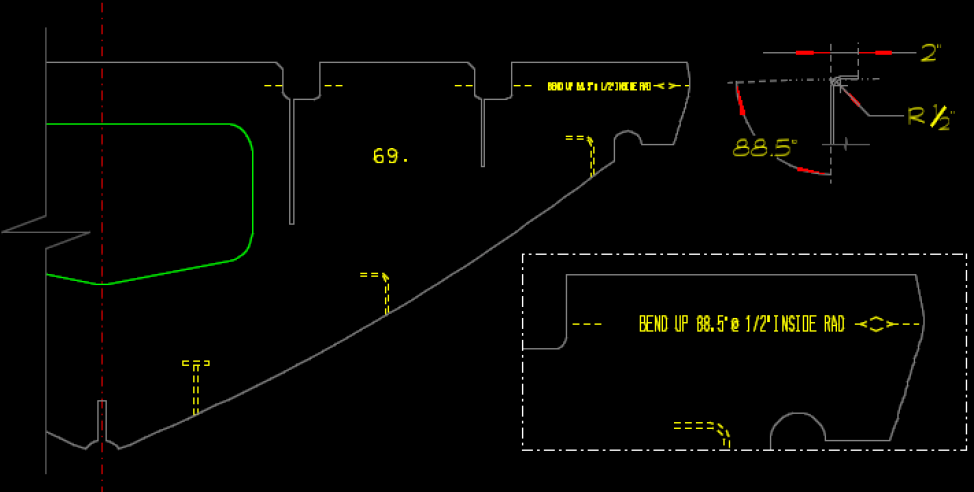
Construction Data. In case of metal boats, all the parts of the boat, have to be flattened out to enable a transfer onto a sheet of material. There can easily be 50 to a 100 individual parts, in even a relatively simple 20ft. At this point the software of choice is Microstation, a powerful 3D and 2D modelling and drafting tool, a functional equivalent of popular AutoCAD. Microstation has its own drawing format called dgn, but it can read and write AutoCAD dwg files. All the parts are now “nested” onto a range of sheets of various alloy grades, sizes and thicknesses. There are software packages capable of automatic nesting, however, we find that there is still no substitute for a human eye, when it comes to utilizing the available material efficiently. Our nesting is done in Microstation – “by hand”, to get the most out of the available material. At this point, after the nesting is complete, a list of material can be created, to be sent out for quotes from suppliers and shops that will CNC cut the individual parts out, and form certain elements( like flanges), depending on the particulars of the individual design.
CNC Cut and Formed Parts. Each individual part has its own number, etched onto it, to eliminate the possibilityof a mix up. These numbers are referenced in the assembly drawings.Intersections and lines along which parts meet, in a complete boat, are etchedonto the parts, to facilitate In case of parts designed to be break press formed( flanges, etc.), the break linesand break details are etched onto the parts.
Documents. 2D assembly drawings are created, as one of the last stages, to incorporate all the necessary details, vital to construction. Drawings are provided in pdf format, easy to print to scale at any reprographic store, or even at some larger office supplies stores. As an addition to technical drawings, we also provide a visual construction sequence, a series of 3D renderings, showing, step by step, the boat being completed out of individual parts. We believe this goes a long way in making the assembly process easier, and is much more readily understandable than “dry” technical 2D drawings alone.
Construction. If required, we can provide help arranging the material purchase and cutting, through a number of reputable suppliers and fabricating shops in Western Canada and the U.S. We can also recommend an experienced aluminum boat builder, if you prefer to have the metalwork completed by a well equipped, dedicated metal fabricator. If at all possible we will be happy to participate in the sea trials of the new vessel.